


You Asked, We Answer
You Asked, We Answer
There is a lot of discussion about energy and power rates in Nova Scotia, and it's important that you—Nova Scotians—have the facts so you can make your own informed opinions and decisions about energy policy and your own energy use. The Q&As below are meant to provide information based on common questions and issues we hear from you. We encourage you to submit your own questions, too.
Rates and Comparisons

Why is Nova Scotia Power raising power rates in 2026 and 2027?
We are making critical reliability investments to make the grid as strong and resilient as possible. Our Reliability Plan includes over $1.3 billion in reliability-focused upgrades over five years, including storm hardening, vegetation management, and grid modernization.
Investments in reliability allow us to:
- Proactively invest in the grid to make it stronger and more reliable
- Expand tree trimming and vegetation management programs to reduce outage risks
- Upgrade our infrastructure to prevent future failures and ensure long-term reliability
- Improve storm response to get the lights back on faster after extreme weather events
- Enhance customer communication to provide real-time updates on outages and restoration
How do Nova Scotia Power’s rates compare to other provinces?
Electricity prices and rate structures vary significantly across Canada.
While Nova Scotia's rates have historically been higher than the national average, the province has become increasingly competitive in recent years, moving closer to the middle of the pack among Canadian jurisdictions.
Provinces with significant, economical hydro resources (e.g., Quebec, Manitoba) or crown corporations with substantial government subsidies (e.g., Ontario, New Brunswick) typically have the lowest rates in the country while Nunavut and the Northwest Territories have the highest costs due to their isolated grids and reliance on diesel generation. Alberta, Saskatchewan, and Prince Edward Island generally have had the most expensive prices in recent years.
Electricity rates are subsidized by government in multiple jurisdictions in Canada. One of the most transparent is in Ontario where there are two main subsidies, the Ontario Electricity Rebate (OER) and the Renewable Cost Shift (RCS). Both are direct subsidies that are paid for by the Government of Ontario. The OER provides a 23.5% rebate on residential, small business, and farm electricity bills. The RCS provides a rebate on all customers’ bills ranging from approximately 10–16%. Without subsidization, Ontario rates would be higher than rates in Nova Scotia.
Residential rates in New England states are substantially higher than in Nova Scotia despite similar weather and geography.
Here's how Nova Scotia's residential rates compare across Canada and New England:
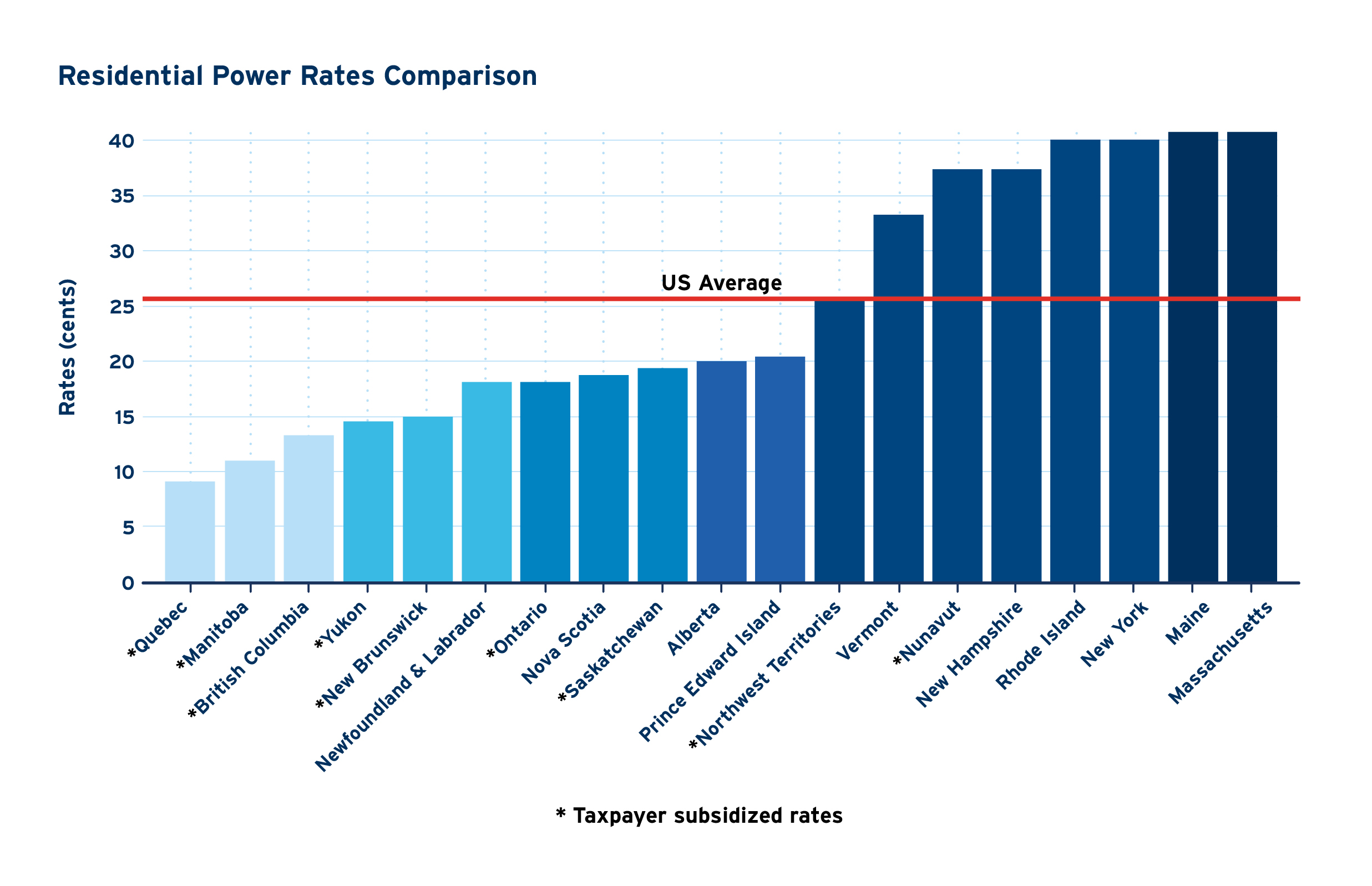
Sources: Canada Energy Regulator, Market Snapshot (2025) and electricchoice.com (2026)
Why do electricity prices differ so much between provinces?
Key cost drivers include access to low‑cost hydro, exposure to extreme weather and storms, customer density, and government policies and subsidies. While larger population centres, like Halifax, Sydney, Bridgewater, and Truro have higher customer density, the geography and rural nature of many Nova Scotian communities mean that customers are more spread across the province, requiring more infrastructure to reach smaller numbers of customers. Combined with limited access to low‑cost hydro resources compared to some other provinces, and increasing storm impacts, these factors contribute to higher system and service costs.

What is securitization?
Securitization is like moving your credit card balance to a lower interest rate loan. You still owe the same amount, but you are charged with less interest.
It’s a financial tool that’s designed to keep rates lower for customers. The financing tool will allow us to refinance certain existing costs using lower interest rate bonds and pass those savings onto our customers.
What does securitization mean for customers?
Are there low-income rate programs in Nova Scotia, and how do they compare to elsewhere?
While electricity rates in Nova Scotia are set by the Nova Scotia Energy Board, the current legislation does not allow the Energy Board to create rates based on distinctions, such as income level. Creating a new rate, like a low-income electricity rate, would require changes to the Public Utilities Act.
We work with low-income advocates, community partners, the Energy Board, and the government on ways to better support low-income customers. In the meantime, we continue to strengthen existing programs that provide direct help, including the HEAT Fund and other customer support programs.
Other provinces lower electricity bills through government subsidies and rebates. For example, Ontario offers several electricity support programs. You can learn more at the above question and chart titled How do Nova Scotia Power’s rates compare to other provinces?
How does your requested increase to power rates compare to recent price changes for
other essential needs and services?
Grocery prices have risen 3% in Nova Scotia. In Halifax, other utilities such as Halifax Water are increasing rates by more than 18% in 2026.
Nova Scotia's all items Consumer Price Index (CPI) grew 5.1% year-over-year in August 2026, up 0.1% from July. Nationally, consumer prices grew 3% year-over-year in August 2026. (Nova Scotia Department of Finance)
System and Oversight
Who oversees Nova Scotia Power and how are decisions made?
Our Board of Directors provides oversight and governance to our leadership team, and the Nova Scotia Energy Board provides regulatory oversight based on laws established by the Province of Nova Scotia. Rates, capital investments, and returns on those investments are reviewed through public filings and hearings that include testimony from us and third-party experts, as well as questions from various customer representatives and intervenors. Decisions made by the Energy Board are publicly available at nserbt.ca.
.jpg?sfvrsn=f9ac186c_0&MaxWidth=1500&MaxHeight=1500&ScaleUp=false&Quality=High&Method=ResizeFitToAreaArguments&Signature=61AD5E77E71BBDBC0C6E80282A2A8E29C83BFF76 "PLTs")
What are Nova Scotia Power's performance standards?
Performance standards hold us accountable. They ensure we're able to demonstrate how we're staying on track and where we've made improvements to strengthen our grid and service for our customers.
The performance standards are set by our regulator, the Nova Scotia Energy Board, and we report on them to the Energy Board annually, at which time there is an open process to consider the report and solicit feedback and comments from customer representatives and intervenors before the Energy Board provides its views.
With our performance standards we are expected to meet three key performance areas:
- Day-to-day customer service: This includes how quick we are to answer customer calls, turnaround time of key customer service requests, how outage information is shared, and what percentage of our bills are estimated.
- Storm response: This measures our response to storms and extreme weather, like snowstorms and hurricanes.
- Reliability of service: This includes how often customers experience a power outage on average and how long the outage lasts.
In 2025, the Energy Board determined that we fell short on two of our 14 reliability targets tied to outage duration and circuit downtime.
We know that there is more work to do, and our team is committed to continuing to improve service for our customers. We are executing our Five-Year Reliability Plan to ensure customers have the service they can count on. We also continue to meet with customers, stakeholders, and elected officials through community reliability meetings to hear and discuss their concerns and incorporate their feedback.
How are electricity rates set through the public process?
Rates are regulated and reviewed through a public process. We must apply to the Nova Scotia Energy Board to change power rates through a process called a General Rate Application. Power rates reflect the real cost of producing and delivering electricity in the province. The Energy Board examines evidence in open hearings and issues public decisions.
We know that there is never a good time to request an increase in electricity rates and that even small increases can have a big impact on families and businesses. The reliability of the service we provide has never been more important to our customers. The focus of our 2026/27 General Rate Application is improving reliability through investments in our system. In keeping with the regulatory process in Nova Scotia, the Energy Board evaluated all the evidence and ultimately determined what rates to set for customers.
Finance, Return on Equity, and Credit
What is return on equity and who decides the allowed amount?
Return on equity (ROE) is the allowed return we can earn on shareholder invested capital in the electricity system. It is set by the Nova Scotia Energy Board and reviewed through public hearings with various intervenors. In Nova Scotia, rates are currently set using a 9% ROE; however, this is not guaranteed. In each year since 2020—with the exception of 2021—we have earned well below nine percent.
In 2025, Nova Scotia Power earned a total return on equity (aka profit) of approximately $140 million. However, the company also invested over $710 million (capital budget spending) in the electrical system in 2025. Annual capital budget spending in Nova Scotia between 2021–2025 was an average of approximately $500 million every year.
For ROE comparison with other utilities, see the table below:
| Company | Maximum Return on Equity | Allowed Equity Percentage |
|---|---|---|
| Nova Scotia Power | 9.00% | 40.0% |
| FortisBC | 9.65% | 41.0% |
| Maritime Electric Company Ltd. | 9.35% | 40.0% |
| Ontario Transmission and Distribution Utilities | 9.11% | 40.0% |
| Ontario Power Generation | 9.11% | 45.0% |
| Alberta Electric Utilities | 8.97% | 37.0% |
| Newfoundland Power | 8.60% | 45.0% |
Is profit guaranteed for Nova Scotia Power?
No. The return approved by the regulator is a maximum allowed amount, not a guarantee. Some costs are not allowed to be recovered, and actual returns can be lower than the approved return. Performance is reviewed over time. In Nova Scotia, rates are currently set using a 9% return on equity; however, this is not guaranteed. In each year since 2020—with the exception of 2021—we have earned well below nine percent.
What else is being done to reduce costs for customers?
In 2024, both the provincial and federal governments took steps to help reduce the impact of high fuel costs on our customer rates: the federal government provided a $500 million loan guarantee, while the province proposed assuming responsibility for $117 million in fuel costs. Together, these measures help reduce rate increases.
Securitization is another tool to address affordability. See the above question What is securitization? to learn more.
To support the provincial and federal government’s clean energy Path to 2030, approximately $117 million of federal funding was allocated for development and execution of our three 50-MW battery storage projects in Bridgewater, Waverley, and White Rock. These battery sites will continue shaping our energy future, providing safe, reliable, and clean energy during peak demand.

What is Nova Scotia Power’s credit rating, why does it matter, and how does it
compare to similar utilities?
Credit rating agencies, such as S&P Global, currently rate us at a BBB- with a negative outlook. It is the lowest among regulated utilities in Canada and among the lowest in North America. The average credit rating for a regulated utility in North America according to S&P is in the BBB+/A- range due in part to regulatory stability. A lower credit rating increases borrowing costs, which, according to how we are regulated, can increase costs and in turn also customer rates.
Your Bill and Costs

Where does my money go when I pay my power bill?
We are a regulated ‘cost-of-service' utility, meaning that what you pay goes directly to the power system: fuel and purchased electricity, maintaining equipment like poles, wires, and substations, storm response and restoration, and system upgrades and reliability improvements.
A significant portion of electricity is also purchased from third-party generators under long-term contracts to meet clean electricity requirements, as determined by the government. A portion of what you pay also goes towards a regulated return for shareholders, which is effectively what we must pay them for the use of their money, just like the interest you pay to a bank or lender. There is a common misconception that we earn “guaranteed profits”—included in our rates is the cost we must pay investors for the use of their money, but there is no guarantee we recover the full amount. In Nova Scotia, rates are currently set using a 9% return on equity; however, this is not guaranteed. In each year since 2020—with the exception of 2021—we have earned well below nine percent.
Why do fuel costs affect rates?
The fuel used to generate electricity is a direct pass-through cost to customers with no mark-up. Customers pay the actual cost of fuel, no more and no less. Fuel costs (like those at the gas pump) can change dramatically based on world, economic, and other market events. When fuel costs change in the market, they affect overall electricity costs. Fuel costs are recovered through a regulatory process called the Fuel Adjustment Mechanism (FAM). We apply to the Nova Scotia Energy Board, who oversees the independent auditing of our fuel spending and issues a decision on fuel cost recovery.
Reliability and Weather
How have changing weather trends affected outages and restoration?
Nova Scotia is experiencing more frequent severe storms, higher wind speeds, and
increased weather volatility. The province now has significantly more high wind hours than
a decade ago. These conditions increase stress on the system and affect outages and
restoration efforts. We experienced 99 hours of wind with gusts over 80 km/hr in 2024, and this trend continued into 2025 with another 93 hours of gusts exceeding 80 km/hr.
91981b8ad99e46f79e085c9b8bac2ecb.jpg?sfvrsn=f2028f10_3 "Image (2)")
How much is being invested in reliability and what is the impact?
We are investing more than $1.3 billion over five years in reliability improvements. The total investment in reliability will reach a 20% increase by 2030 when compared to 2023. We're already seeing results, including tree-related outages down 19% and equipment-related outages down 18 percent.
These investments support tree trimming near power lines, replacing poles and wires with stronger, more durable equipment, upgrading substations and equipment, and launching new grid technology to identify outages and restore power faster. With the investments being made through the Five-Year Reliability Plan we are on track to achieve our performance standards for reliability as set out by the Nova Scotia Energy Board by 2029.

What are the real facts on Nova Scotia Power’s reliability performance over the past five years?
We’re making progress. While severe weather continues to influence year-to-year results, recent performance outside of major storms demonstrates measurable progress and reflects the positive impact of our sustained focus on proactive maintenance, system resilience, and operational improvements.
Over the past five years, our reliability performance has improved as reflected in both the System Average Interruption Duration Index (SAIDI)—average outage duration—and the System Average Interruption Frequency Index (SAIFI)—average outage frequency—results. With our Five-Year Reliability Plan, we have significantly increased investment in vegetation management, targeted infrastructure renewal, and grid modernization. Our customers are experiencing fewer outages, and, on average, shorter restoration times compared to earlier in the five-year period.
How is reliability measured and how does Nova Scotia compare to similar regions?
Reliability is measured using industry-standard metrics that track how often outages occur and how long they last. One key metric is the System Average Interruption Frequency Index (SAIFI), which measures the average frequency of outages, while another, the System Average Disruption Index (SAIDI), measures the average duration of outages. We use these figures to help determine how and where we invest to improve reliability. Our Five-Year Reliability Plan includes targeted investments aimed at improving both the frequency and duration of outages for our customers.
Based on Electricity Canada's Distribution System Performance: Electric Power System Reliability Assessment (2024) study, we have slightly outperformed other Atlantic Canadian utilities in terms of outage frequency and outage duration. Overall, our reliability of service is comparable to other Atlantic Canadian utilities.
We are held accountable through the performance standards, which tie directly to system reliability. We report on all performance standards annually, and the Nova Scotia Energy Board assesses the results and delivers findings.
Economy and Community
What is Nova Scotia Power’s total economic impact in the province?
With more than 2,200 team members calling this province home, we are proud to live, work, and play in Nova Scotia. Nova Scotia is a special place, and we are proud to be your neighbours. Our team members are community leaders, volunteer fire fighters, local team coaches, and fulfill many other volunteer roles in their communities.
We employ and support over 7,100 indirect and direct jobs in the province, contributing $1 billion to provincial Gross Domestic Product (GDP) and have an annual capital investment of about $2.4 billion.
With over 4,200 local suppliers, we are proud that 94% of all materials we procure come from Canadian resources; 60% being directly from within the province.
.jpg?sfvrsn=7b3e684d_0&MaxWidth=1500&MaxHeight=1500&ScaleUp=false&Quality=High&Method=ResizeFitToAreaArguments&Signature=29335F4298E6EA976E9BC9885665754D493EC6FC "Pride Parade_Truro_2025")
What is Nova Scotia Power's role in the development of data centres?
Our primary focus is to provide safe, reliable electricity to our customers who live, work, and operate in the province.
When requests for new customer connections arise, we work closely with the government and the Nova Scotia Energy Board to understand the requirements, including evaluating how the business, like a data centre, could be served safely and reliably while protecting rates for our customers.
The Independent Energy System Operator (IESO) is responsible for making sure the province's electricity system can meet future demand. For a large new customer, the IESO assesses whether additional power supply would be needed to serve this demand, and works with our teams on whether upgrades to the electricity grid are necessary.
How will data centres impact customers and rates?
Existing customers would not be responsible for paying for infrastructure built specifically to serve a new customer or their project.
We are aligned with the provincial government that costs created by the development of data centres should not negatively impact power rates for our existing customers.
Any major projects, like data centres, that want to connect to the system will go through established planning and regulatory reviews. These reviews determine what infrastructure is needed and who pays for it.